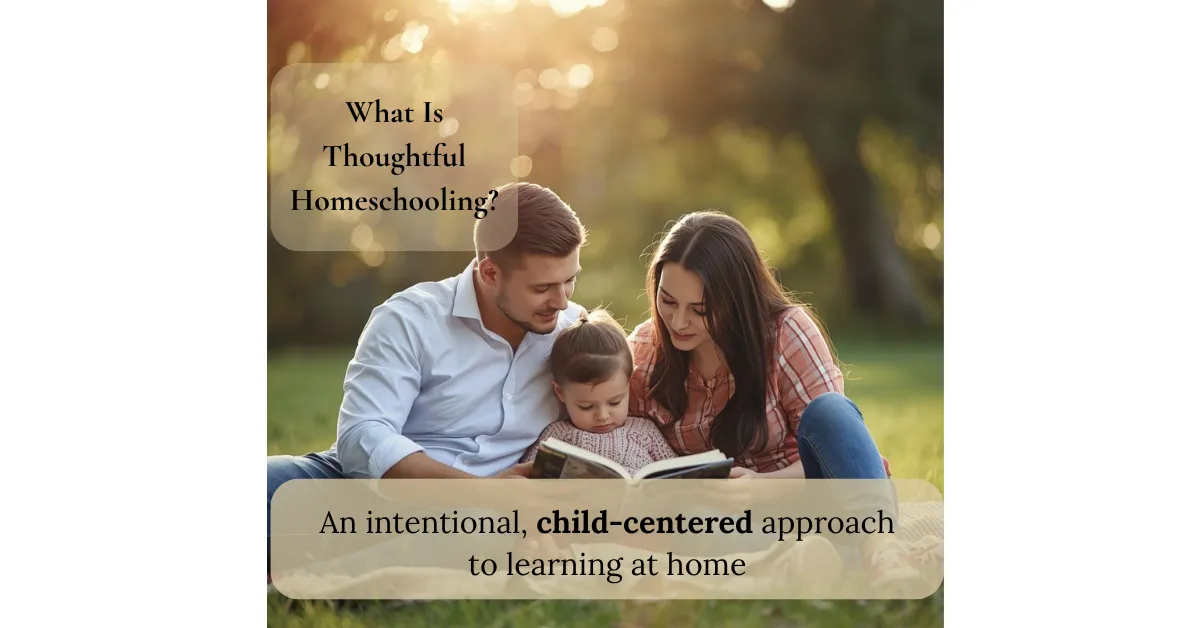
What Is Thoughtful Homeschooling? An Intentional Home Centered Approach to Home Learning
Building a Home Education with Intention
Many families begin homeschooling not because they were searching for an alternative, but because something about traditional schooling no longer felt right.
The pace felt rushed.
The work felt disconnected.
And the child in front of them—curious, sensitive, imaginative—seemed increasingly unseen.
If you’ve ever felt that tension, you are not alone.
Thoughtful homeschooling begins with a simple shift:
Education is not the transfer of information—it is the formation of a person.
Instead of asking How much can we get through? we begin asking:
Who is my child becoming?
What habits are we building?
What kind of home atmosphere supports growth?
How can learning feel peaceful, meaningful, and sustainable?
In this post, you’ll learn what thoughtful homeschooling is (and what it is not), why literature matters so deeply, and how Charlotte Mason’s principles offer a steady foundation for families who want depth over pressure.
🌿 If you’d like a gentle guide to help you build consistent reading habits at home, download my free Gentle Reading Habits Starter Kit here.
👉 [Insert your
What Thoughtful Homeschooling Is (and Is Not)
Thoughtful homeschooling is not about recreating school at home. It is not driven by fear, comparison, or constant measurement. It does not rely on endless worksheets, rigid schedules, or pressure to perform.
Instead, thoughtful homeschooling is:
Intentional — guided by clear values and long-term vision.
Relational — rooted in close attention to the child as a person.
Literature-rich — nourished by ideas, stories, and language that matter.
Formative — concerned with habits, character, and discernment.
Sustainable — designed to support both parent and child over many years.
At its heart, this approach respects the child as a whole person—mind, heart, body, and spirit.
Why Many Families Choose Homeschooling
Families choose homeschooling for many reasons, but thoughtful homeschooling often grows from shared concerns:
Children learn at different paces and in different ways
Curiosity and love of learning can be dulled by constant testing and pressure
Education has become increasingly fragmented and impersonal
Moral and intellectual formation is often treated as secondary
Homeschooling offers families the freedom to slow down, to adapt, and to place relationship and meaning at the center of learning.
The Role of Reading in a Thoughtful Education
Reading is foundational to thoughtful homeschooling—not simply as a skill, but as a way of encountering ideas. Through rich language and well-told stories, children learn to think, imagine, empathize, and discern.
This is why quality literature matters. Well-written books invite children into living ideas rather than fragmented facts. They cultivate attention, deepen understanding, and awaken a hunger for truth and beauty.
If reading feels difficult or discouraging, support can be gentle and patient. Skills grow best when they are nourished rather than forced.
→ Explore Growing Readers at Home: A Gentle, Literature-Rich Approach
A Charlotte Mason–Inspired Foundation
Much of the philosophy behind thoughtful homeschooling has been shaped by the work of Charlotte Mason, a British educator who believed that children are born persons and deserve an education worthy of them.
Her approach emphasizes:
Living books instead of dry textbooks
Narration as a natural way of processing knowledge
Short lessons that protect attention
Habit training that supports character and freedom
Respect for the child’s intellectual and moral life
These principles do not require perfection or rigid adherence. They offer a framework that many families find both humane and enduring.
→ Read Charlotte Mason and the Formation of the Whole Child
The Parent’s Role: Guide, Learner, and Steward
In thoughtful homeschooling, the parent is not merely a supervisor or task manager. The parent becomes a guide—one who selects worthy material, models curiosity, and continues to grow alongside the child.
This is why mother culture and parent learning matter. As children mature, so must the ideas and inner life of the educator guiding them. Education becomes a shared journey rather than a set of assignments to complete.
The parent as steward is watching for pitfalls to avoid while allowing the child to take certain risks.
Moving Forward with Confidence
Thoughtful homeschooling does not require having everything figured out. It grows through attention, patience, and a willingness to choose depth over speed.
You can begin simply:
Choose fewer, better books
Protect time for reading and conversation
Observe your child carefully
Allow learning to unfold steadily
Over time, these small choices shape a home where learning feels meaningful and humane.
Where to Go Next
This post is part of the Homeschool Foundations Series, created to help families build a home education that is peaceful, purposeful, and rooted in what truly matters.
If you’re ready to continue, here are three next steps depending on what your family needs most right now:
🌿 If You Want to Strengthen Reading at Home
Reading is the foundation of nearly every subject—and it can be nurtured gently, even when a child struggles.
→ Growing Readers at Home: A Gentle, Literature-Rich Approach
(practical support for reading, language, and confidence)
📖 If You Want the Charlotte Mason Framework
Charlotte Mason’s philosophy offers an enduring foundation for families who want an education shaped by truth, beauty, and goodness.
→ The Heart of Charlotte Mason: Living Books, Habits, and Mother Culture
(the philosophical foundation behind thoughtful homeschooling)
🤍 If You Want Personalized Support
Some children need more than encouragement—they need targeted instruction that builds skill and confidence step by step.
If your child is struggling with reading fluency, comprehension, or handwriting, individualized tutoring is available for families seeking gentle, personalized guidance.
→ Schedule a Free 30-Minute Tutoring Consultation
If you’re ready to continue, here are three next steps depending on what your family needs most right now:
Growing Readers at Home — practical support for reading and language development
The Heart of Charlotte Mason-Living Books, Habits, and Mother Culture— the philosophical foundation behind this approach
Thoughtful homeschooling is not about doing more. It is about choosing what truly matters.